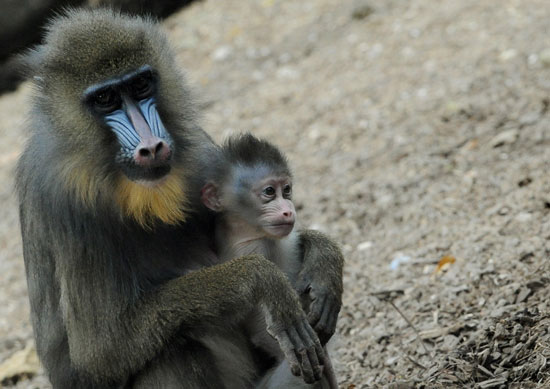
Female Mandrill with her Baby
Opposites attract! One of the most common sayings in the world. We humans seem to believe so, but do we really know why opposites attract?
Mandrills (Mandrillus sphinx) are the world’s largest species of monkey and very closely related to man. They are best known for their colorful faces and rumps. Male mandrills have red, purple and blue skin on their face, rump and genitalia, distinguishing them from the less colorful females. They are highly social animals, known to live in groups of up to about 800 individuals. Living in such close proximity with high number of individuals means there is usually no dearth of mates. But mating constantly within the group can lead to inbreeding and thus reducing the fitness of the future generations of mandrills.
Female mandrills seemed to have found a unique solution to the inbreeding problem – mate with males that are genetically most different from them. Determining the genetic difference of an individual from oneself is no easy task. But it is known that a lot of female mammals follow their noses to the potential father of their offspring. Odor plays a very important role in mating. Female mandrills know their own body odor, and body odor is also determined partly by genetic make-up of an individual. This means that any male with a different body odor will be genetically different from them. How this process works is still a mystery, but scientists have theorized that finding mates whose body odor is completely different from their own, helps females determine the extent of genetic difference of the male. Thus ensuring that the next generation of mandrills have higher fitness (are able to pass on their genes successfully). Male mandrills have external glands on their chests which they rub against trees and females pick up these scents. During courtship, the female mandrill follows the male around, and if the male is interested then he mounts her. Following a male with as different a body odor is the female’s way of ensuring she’s doing the best for her offspring.
Humans and mandrills are both anthropoid monkeys. Being so closely related to each other, it may be safe to theorize that humans, too, look for genetic diversity in their mates as well. It may be part of the sub-conscious or genetically coded into women, but how this works is something of an enigma.

No comments:
Post a Comment